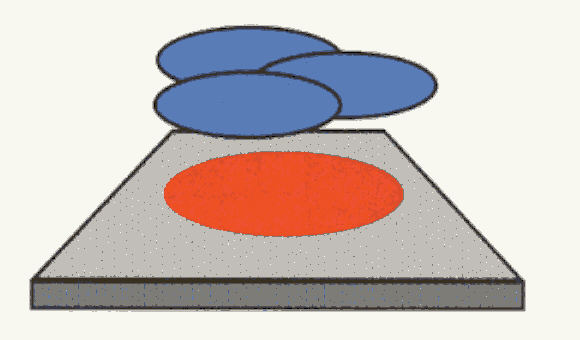
There is a carnival that comes to town at Apple Blossom time in Winchester, Virginia. There is one carnival concession in which, for the price of a ticket, you drop three identical disks several feet onto a painted circle. If they cover the target circle so that no part of it is exposed, you win a prize.
The operator usually lays the disks down first to prove that they can cover the circle completely. The challenge is difficult because the circle is the maximum size that the disks can cover.Imagine that you're setting up one of these concessions. If your disks are four inches in diameter, what should be the diameter of the target circle?
Solution to the Problem:
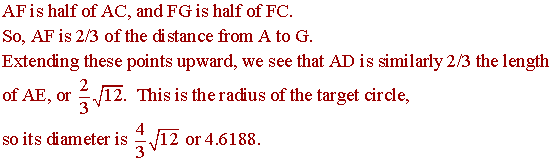
The maximum diameter of the target circle is about 4.61 inches.
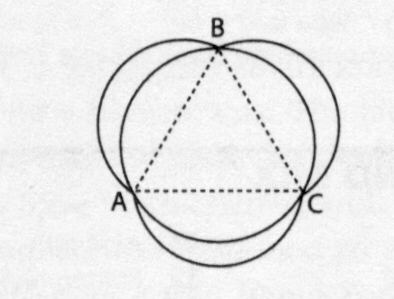
Points A, B and C are on the circumference of the target circle (shown here on top of the disks). A, B and C are also the ends of three lines across the disks. The longest possible line across a disk is its diameter. So lines AB, BC, and CA must equal the diameters of the three disks (4") if the target circle is to be the maximum size that can be covered by the disks.
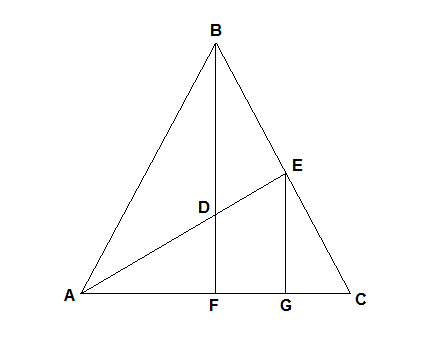
The radius of the target circle is the distance from A, B, or C to the center of the circle at D. AE and BF extend from A and B to the centers of the opposite sides of triangle ABC, and their intersection at D is the center of the target circle. AEC is a right triangle with hypotenuse AC of 4" (the circumference of a disk) and side EC of 2". So, by the Pythagorean Theorem, AE is the square root of 12 (42 - 22).
Correctly solved by:
| 1. Richard K. Johnson | La Jolla, California |
| 2. JoAnn Reynolds | Spring Hill, Florida |
| 3. Jaci Egley | Mountain View High School, Mountain View, Wyoming |
| 4. Shay Murray | Mountain View High School, Mountain View, Wyoming |
| 5. Chris Maldonado | Mountain View High School, Mountain View, Wyoming |
| 6. Halie Gardner | Mountain View High School, Mountain View, Wyoming |
| 7. Kristi Harmon | Mountain View High School, Mountain View, Wyoming |