Wrecked Angle
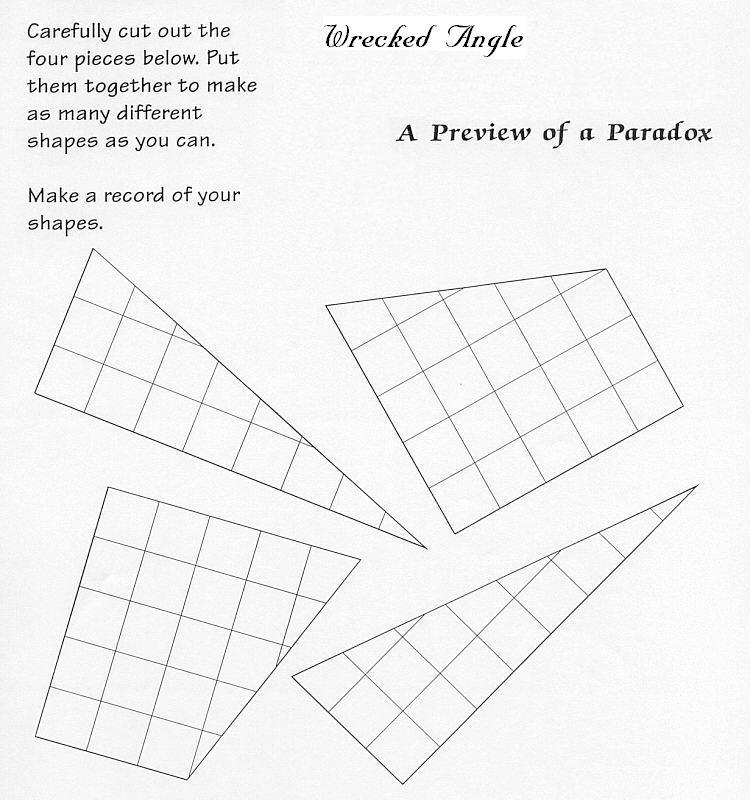
              (1) Determine the area of each of the four original shapes.
                  (A) Right Triangle: _______
                  (B) Right Triangle: _______
                  (C) Trapezoid: ____________
                  (D) Trapezoid: ____________

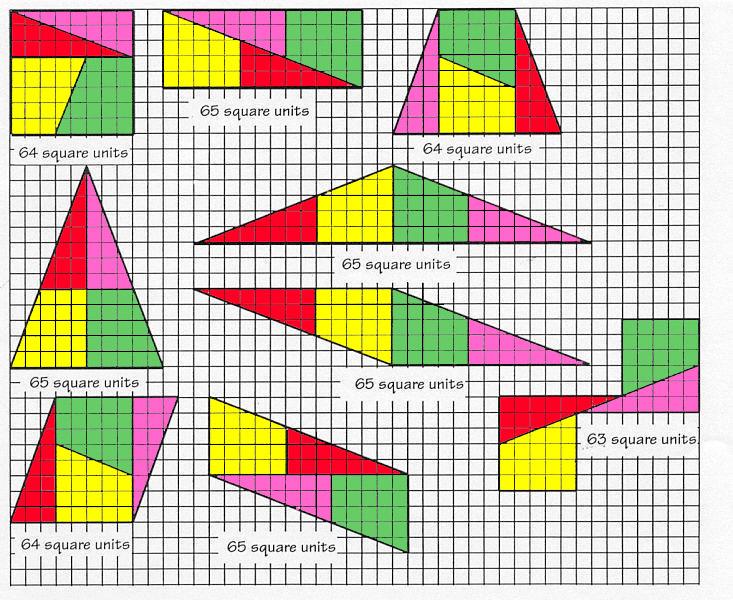
              (2) Determine the area of each of the figures that you formed
                  with the four shapes:
                  (A) Square: _______________
                  (B) Rectangle: ____________
                  (C) Triangle: _____________
                  (D) Trapezoid: ____________
                  (E) Octagon: ______________
                  (F) Parallelogram: ________
                  (G) Another Triangle: _____
There appears to be a paradox! Some of the figures have 63
square units, some have 64 square units, and some have 65 square units.
Here are some solutions for the figures above: |
|
How do you explain this impossible situation?
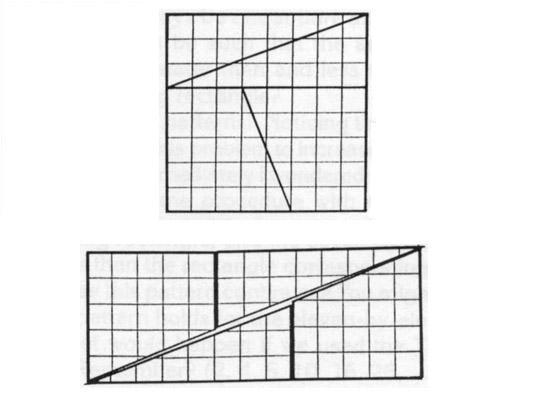
Take a closer look at the first two figures -- the square and the rectangle.
The four pieces fit snugly together for the square.
|
|
How can you prove this?
If the pieces indeed did fit together to form a rectangle, then the diagonal would be one line segment. If it is just one segment, then it would have just one slope, since the slope of a line is always the same. Determine the slopes of the four pieces that form "the" diagonal (the slopes should be 2/5, 2/5, 3/8, and 3/8). Notice that they are not the same. Therefore, it is not one segment (which can be seen in the drawing above). |