 ,
where F is the
force (a vector) and W is the weight. When a driver slams
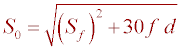
on the brakes and the car skids to a stop, its minimum speed
can be estimated by using the formula
,
where F is the
force (a vector) and W is the weight. When a driver slams
on the brakes and the car skids to a stop, its minimum speed
can be estimated by using the formula
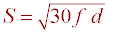 , where S is the
speed of the car in miles per hour, f is the drag factor or
coefficient of friction, and d is the length of the skid marks
measured in feet.
, where S is the
speed of the car in miles per hour, f is the drag factor or
coefficient of friction, and d is the length of the skid marks
measured in feet.
 ,
,  , where M
denotes mass, W denotes weight, and g denotes gravity
(32 feet per second per second).
, where M
denotes mass, W denotes weight, and g denotes gravity
(32 feet per second per second).
 ,
,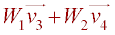 ,
can be broken down into the horizontal and vertical components
,
can be broken down into the horizontal and vertical components
 , and
___________________________, respectively, where
, and
___________________________, respectively, where
 and
and
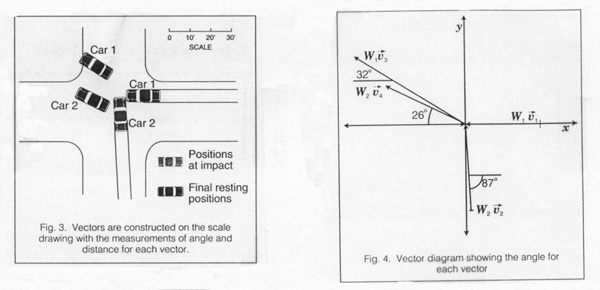
 represent the directions of vectors v3 and
v4. By using the formula for the conservation
of linear momentum and taking the magnitudes of vertical and horizontal
components, we obtain
represent the directions of vectors v3 and
v4. By using the formula for the conservation
of linear momentum and taking the magnitudes of vertical and horizontal
components, we obtain  ,
,  ,
,  and
and
 being the directions for
vectors v1 and v2.
being the directions for
vectors v1 and v2.
 , and
, and
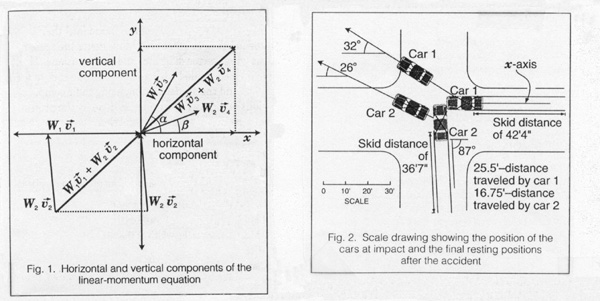
 positioned at the origin and illustrating the paths of the
two vehicles after impact. These vectors are 25.5 feet and 16.75
feet, respectively. If we take the drag factor at the time of
impact to be f = 0.83, then
positioned at the origin and illustrating the paths of the
two vehicles after impact. These vectors are 25.5 feet and 16.75
feet, respectively. If we take the drag factor at the time of
impact to be f = 0.83, then  ,
93,
148, and
154, respectively. Letting
W1 and W2 be 4,220 and 3,875
pounds, respectively, and using the previous values for the magnitudes
of vectors v3 and v4,
substitute into .
,
93,
148, and
154, respectively. Letting
W1 and W2 be 4,220 and 3,875
pounds, respectively, and using the previous values for the magnitudes
of vectors v3 and v4,
substitute into .  ,
,

 ,
,