The Toonerville Transit Company operates a bus line with seven stops -- A, B, C, D, E, F, and G.
Here are some clues about the relative locations of the bus stops:
From A to B is 2 miles.
From A to D is 7 miles.
From C to E is 3 miles.
From C to G is 7 miles.
From E to F is 2 miles.
From E to G is 4 miles.
B is 4 miles due southwest of C.
D is 5 miles due southeast of B.
F is 4 miles due northeast of D.
The bus begins its route at A and passes through every stop once before returning to A, following the shortest path possible.
Unlike most buses, this one always travels in a straight line between stops, and straight roads exist between every possible pair of bus stops.
If the bus stops at B sometime before it stops at C, in what sequence does the bus pass the stops?
Solution to the Problem:
Here is the solution:The shortest route is: A, B, D, G, F, E, C.
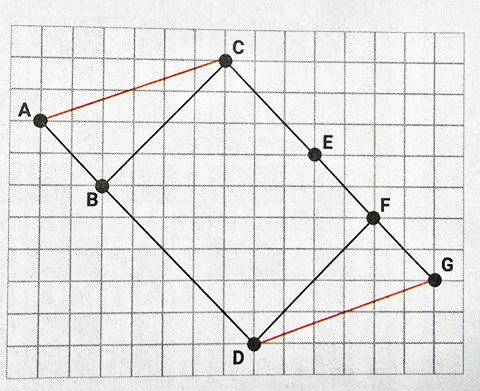
CFDB must be a rectangle because of the last three clues listed.
Hence, CF is 5 miles long and parallel to BD.
Since CE is 3 miles and EF is 2 miles, E must be a point on line segment CF.
CG is 7 miles, CE is 3 miles, and EG is 4 miles, so CEFG is a straight line.
G must be 2 miles southeast of corner F of the rectangle.
AD is 7 miles, AB is 2 miles, and BD is 5 miles, so ABD is a straight line, and A is 2 miles northwest of corner B of the rectangle.
So, the shortest route that travels through every stop must be A, B, D, G, F, E, C, or the reverse A, C, E, F, G, D, B.
But since the bus stops at B before C, the correct answer is A, B, D, G, F, E, C.
Dr. Kishan gets extra credit for sending in the shortest distance, given by
d=2+5+2√5+2+2+3+2√5=(14+4√5) units.
Correctly solved by:
| 1. Dr. Hari Kishan |
D.N. College, Meerut, Uttar Pradesh, India |
| 2. Colin (Yowie) Bowey | Beechworth, Victoria, Australia |
| 3. Davit Banana | Istanbul, Turkey |