A circle with area π square inches is inscribed inside a right triangle.
What are the lengths of the sides of the triangle?
Solution to the Problem:
Here is the solution:The sides of the right triangle are 3 inches, 4 inches, and 5 inches.
A circle with area 𝜋 has radius 𝑟 = 1.
For a right triangle with legs a and b and hypotenuse 𝑐, the inradius is given by the formula
r = (a + b - c) /2
Set r = 1, and you obtain a + b - c = 2
Using the Pythagorean theorem along with the previous equation, you obtain a=3,b=4,c=5.
Davit Banana gets extra credit for finding more than one solution.
Davit pointed out that I did not specify integer solutions, so he sent the following message:
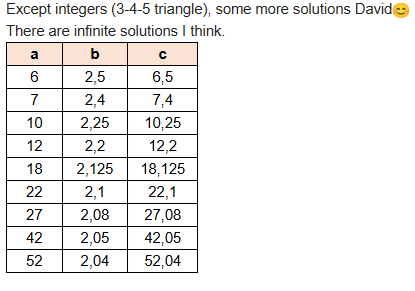
For Americans, the comma in the table corresponds to our decimal point.
Danny of Georgia and Kelly Stubblefield also get extra credit for pointing out that there is an infinite number of solutions.
Kamal Lohia also gets extra credit for pointing out that there is an infinite number of solutions.
Here is his excellent explanation:
Answer: 3, 4, 5 inches
Solution: Area of circle = πr² = π
=> r = 1
So, the three sides of the right triangle are: 1+x, 1+y, x+y
Using Pythagorean theorem, we can write
(1+x)² + (1+y)² = (x+y)²
=> 1+2x+1+2y = 2xy
=> xy-x-y+1 = 2
=> (x-1)(y-1) = 2
=> x,y = 3,2 or 2,3 considering only integral cases else there are infinite solutions.
Dragan Gonzales determiined the sides of an isosceles right triangle that satisfied the original conditions:
Assuming an isosceles right triangle; the hypotenuse is (2+2(2)^1/2) units long, and the legs are each (2+(2)^1/2) units long.
Let points a, b, and c form a right triangle with, b as the right angle, and point d be the midpoint of line ac, the hypotenuse.
Let circle x be inscribed in triangle abc and have an area of pi.
By definition of an inscribed circle, line bd intersects point x.
Let points e and f be where the circle intersects lines ab and bc respectively, thus making them perpendicular to their respective line.
Circle x has an area of pi = pi * r * r, thus a radius of 1, so lines xe and xf are 1 unit long.
This makes square xbef with side lengths of 1 unit.
Line bx now makes the right triangle bex, meaning line bx has a length of 2^.5.
Line xd is a radian so its length is 1, thus line bd has a length of 1 +2^.5.
Line bd makes triangles bcd and abd, which are isosceles right triangles with leg lengths of 1+2^.5 units.
Thus, line ac = 2(1+2^.5) = 2+2(2^.5) units, and lines ab and bc = 2^.5(1+2^.5) = 2+2^.5.
So ac = 2 + 2 √2 ≈ 4.828 and ab and bc = 2 + √2 ≈ 3.414.
Correctly solved by:
| 1. Davit Banana | Istanbul, Turkey |
| 2. Colin (Yowie) Bowey | Beechworth, Victoria, Australia |
| 3. Kamal Lohia | Hisar, Haryana, India |
| 4. Dr. Hari Kishan |
D.N. College, Meerut, Uttar Pradesh, India |
| 5. Danny | Augusta, Georgia, USA |
| 6. Dragan Gonzales |
Central High School, Grand Junction, Colorado, USA |
| 7. Kelly Stubblefield | Mobile, Alabama, USA |