Arrange the numbers 1 through 36 in a circle so that all adjacent pairs add up to a perfect square.
Or you can just send in a list of the numbers, but make sure that your first and last numbers add up to a perfect square.
Solution to the Problem:
Here are some solutions:1, 3, 13, 36, 28, 21, 15, 34, 30, 19, 6, 10, 26, 23, 2, 7, 18, 31, 33, 16, 9, 27, 22, 14, 35, 29, 20, 5, 11, 25, 24, 12, 4, 32, 17, 8 - back to 1
1 – 8 – 17 – 32 – 4 – 12 – 24 – 25 – 11 – 5 – 20 – 16 – 9 – 27 – 22 – 14 – 2 – 23 – 26 – 10 – 6 – 19 – 30 – 34 – 15 – 21 – 28 – 36 – 13 – 3 – 33 – 31 – 18 – 7 – 29 – 35 – (back to 1)
1 - 3 - 6 - 19 - 30 - 34 - 2 - 23 - 26 - 10 - 15 - 21 - 4 - 32 - 17 - 8 - 28 - 36 - 13 - 12 - 24 - 25 - 11 - 5 - 20 - 29 - 7 - 18 - 31 - 33 - 16 - 9 - 27 - 22 - 14 - 35 - back to 1
Kamal Lohia suggested a good way to begin solving the problem:
Possible pair-ups:
1: 3, 8, 15, 24, 35
2: 7, 14, 23, 34
3: 1, 6, 13, 22, 33
4: 5, 12, 21, 32
5: 4, 11, 20, 31
6: 3, 10, 19, 30
7: 2, 9, 18, 29
8: 1, 17, 28
9: 7, 16, 27
10: 6, 15, 26
11: 5, 14, 25
12: 4, 13, 24
13: 3, 12, 23, 36
14: 2, 11, 22, 35
15: 1, 10, 21, 34
16: 9, 20, 33
17: 8, 19, 32
18: 7, 31
19: 6, 17, 30
20: 5, 16, 29
21: 4, 15, 28
22: 3, 14, 27
23: 2, 13, 26
24: 1, 12, 25
25: 11, 24
26: 10, 23
27: 9, 22
28: 8, 21, 36
29: 7, 20, 35
30: 6, 19, 34
31: 5, 18, 33
32: 4, 17
33: 3, 16, 31
34: 2, 15, 30
35: 1, 14, 29
36: 13, 28
Now the numbers with only two possible partners must be paired with them only.
So, we have: 7-18-31, 11-25-24, 10-26-23, 9-27-22, 4-32-17 and 13-36-28
This would be a good starting point. These can be seen in six different colours in the image below provided by Colin Bowey.
Colin Bowey gets extra credit for sending in thirty-one unique solutions to the problem:
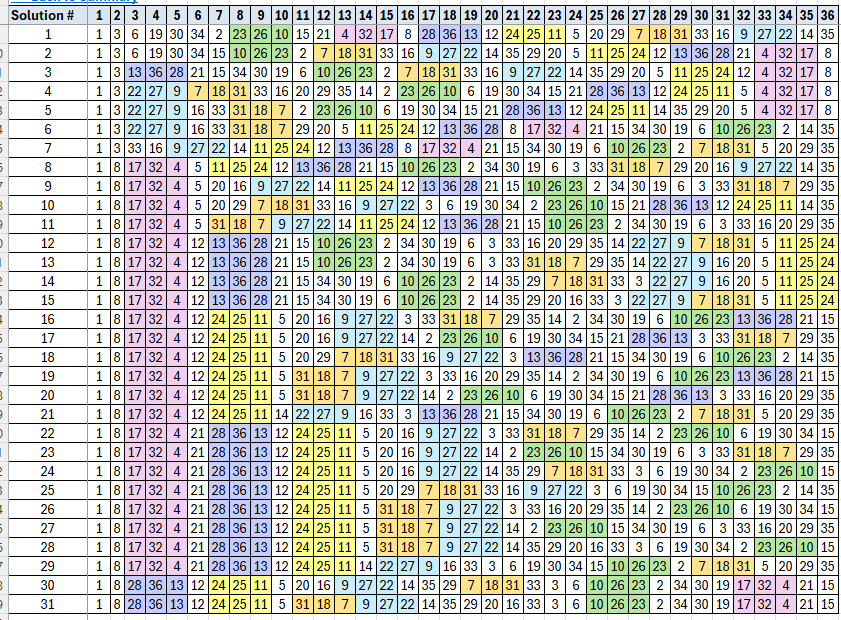
Click here to download a file in Excel which displays the thirty-one solutions in a circle
You will need to enable Macros in Excel.
Colin really went all out on this problem and here is his explanation. He used Visual Basic in Excel to search for solutions for ranges 1 to N, just to see how the number of solutions grows as N increases.
The code models the problem as a graph in which the integers 1 through N are treated as vertices, and an edge is drawn between two vertices whenever the sum of the corresponding numbers is a perfect square.
The task of arranging the numbers in a circle so that adjacent pairs sum to a square then becomes equivalent to finding Hamiltonian cycles in this square-sum graph.
The solver constructs the graph and performs a depth-first backtracking search to explore possible paths, extending partial sequences only along valid edges and retreating whenever a path cannot be completed.
For the range 1 to 36 there are six numbers in the square-sum graph that have only two possible neighbours. Since every vertex in a Hamiltonian cycle must have exactly two adjacent vertices, these degree-two vertices force those edges to appear in any valid solution, effectively locking them into small chains (see below):
7 — 18 — 31
11 — 25 — 24
10 — 26 — 23
9 — 27 — 22
4 — 32 — 17
13 — 36 — 28
To avoid counting duplicate solutions, symmetry is reduced by fixing the starting value at 1 and eliminating reversed duplicates.
Each Hamiltonian cycle therefore corresponds to a unique circular arrangement in which every neighbouring pair of numbers sums to a perfect square.
The first range for which I found a solution was 1 to 32.
The vertex 18 in the square-sum graph requires both 7 and 31 as neighbours.
Therefore the range must extend at least to 31 before a Hamiltonian cycle can even be possible.
However, when the range is limited to 31 the graph contains many additional degree-two vertices (such as 16, 17, 28, 29 and 30), which introduces many forced segments and makes it extremely difficult (in this case impossible) to form a single cycle.
Only when the range is extended slightly further does the graph gain enough additional connections to allow valid circular arrangements to appear.
From 1 to 32, I generated solutions for each range up to 1 to 44.
One interesting observation is the rapid increase in search time. For example:
N=43 took about 8 minutes 18 seconds
N=44 jumped to over 2 hours
That's the reason I stopped at 44. My guess is that searching 1 to 45 might take a couple of days!
It would be interesting to try to predict both how many solutions exist for N=45 and how long the search might take.
Another curious observation was that:
N=38 has 25 solutions
N=40 has 64 solutions
which are themselves perfect squares.
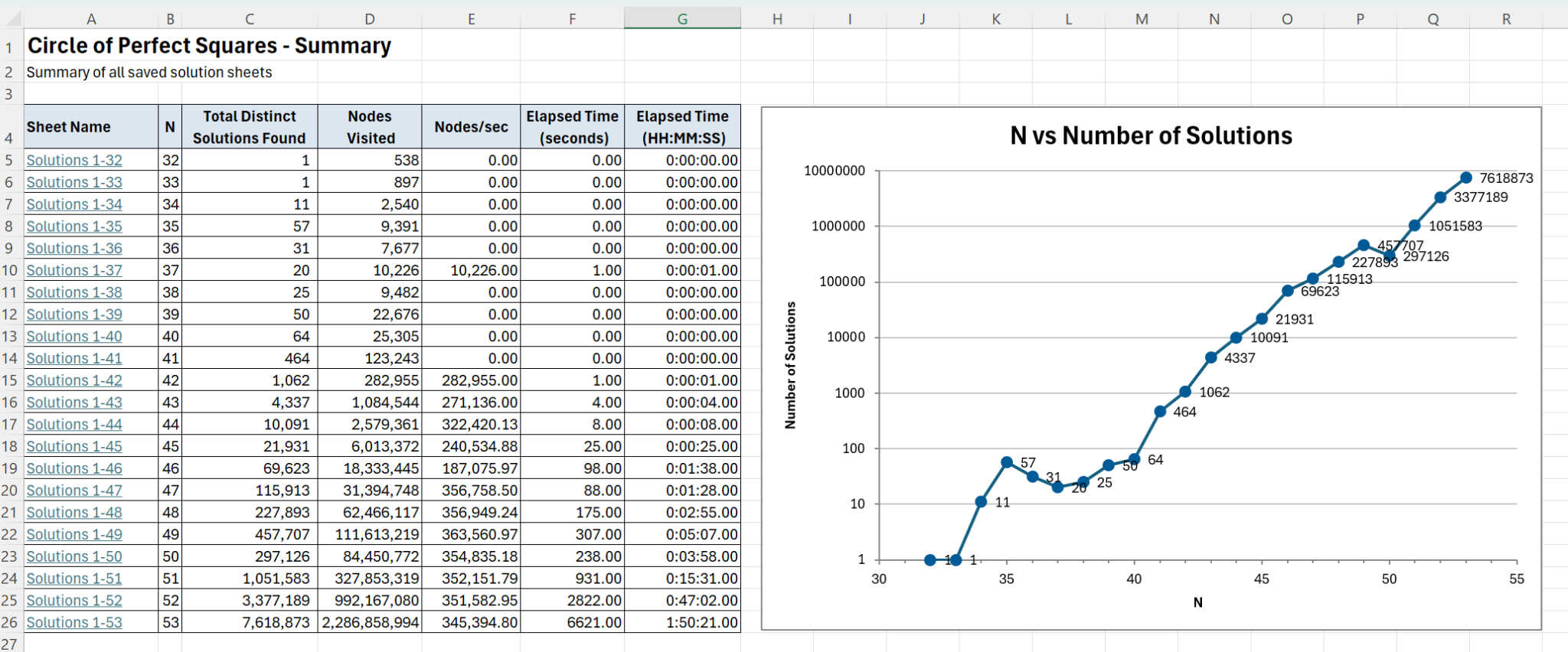
Now, for some real fun, you can download an Excel file in which you can display any of the solutions for number 1 to 32 up to 1 to 44.
Click here to download a file in Excel in which you can enter any N from 32 to 44.
Correctly solved by:
| 1. Colin (Yowie) Bowey | Beechworth, Victoria, Australia |
| 2. Davit Banana | Istanbul, Turkey |
| 3. Kamal Lohia | Hisar, Haryana, India |
| 4. Dr. Hari Kishan |
D.N. College, Meerut, Uttar Pradesh, India |
| 5. Dragan Gonzales |
Central High School, Grand Junction, Colorado, USA |