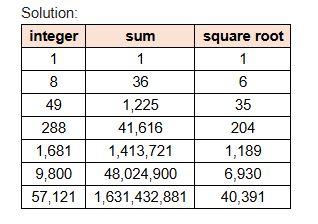
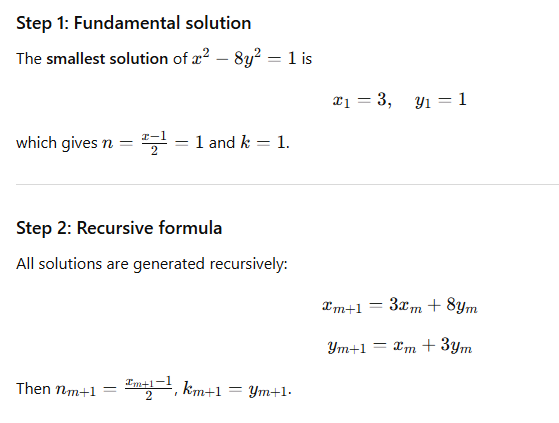
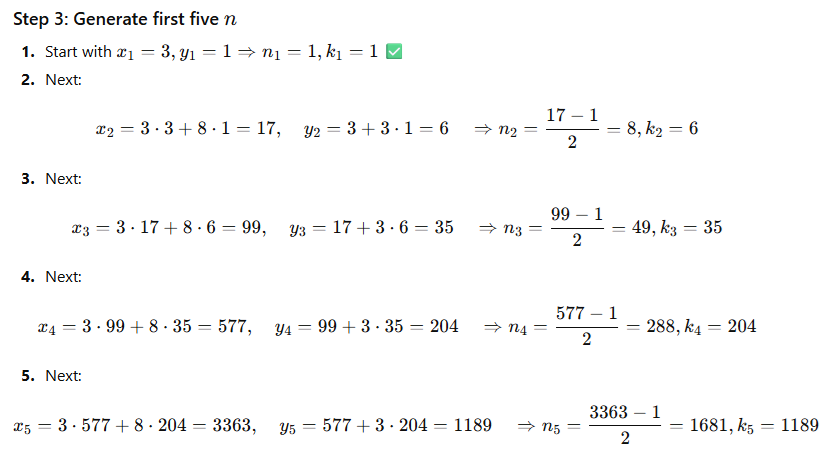
Solution to the Problem: The first five integers n for which the sum is a perfect square are:
1, 8, 49, 288, and 1681.
Reacall that
1 + 2 + 3 + ... + n = (n(n+1)) / 2
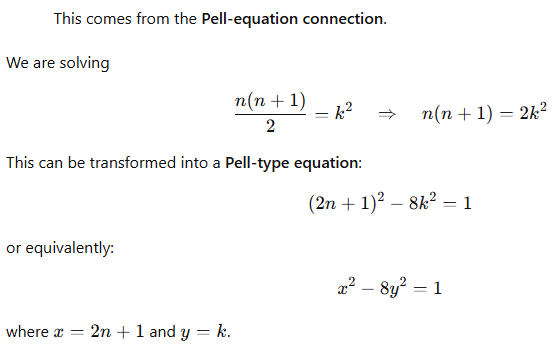
So we are looking for n such that
(n(n+1)) / 2 = k2
| 1. Colin (Yowie) Bowey | Beechworth, Victoria, Australia |
| 2. Kamal Lohia | Hisar, Haryana, India |
| 3. Dr. Hari Kishan |
D.N. College, Meerut, Uttar Pradesh, India |
| 4. Ivy Joseph | Pune, Maharashtra, India |
| 5. Dakoda Perrigo |
Central High School, Grand Junction, Colorado, USA |
| 6. Kelly Stubblefield | Mobile, Alabama, USA |
| 7. Sage Siegrist |
Central High School, Grand Junction, Colorado, USA |