A jewelry store is featuring three rings -- one with a large ruby, one with a diamond, and one with a sapphire.
The total price of the three rings is somewhere between $20,000 and $50,000.
The price of the ruby ring is twice the difference between the prices of the diamond and sapphire rings.
The price of the diamond ring is four times the difference between the prices of the sapphire and ruby rings.
The price of the sapphire ring is an exact multiple of $2,000.
Determine two different sets of possible prices for the three rings.
Solution to the Problem:
Here is the solution:Three solutions are:
(1) Diamond = $16,000, Sapphire = $12,000, and Ruby = $8,000
(2) Diamond = $8,000, Sapphire = $18,000, and Ruby = $20,000
(3) Diamond = $8,000, Sapphire = $14,000, and Ruby = $12,000
Let R = cost of the ring with the Ruby
Let S = cost of the ring with the Sapphire
Let D = cost of the ring with the Diamond
Then we can write the following algebraic statements:
R = 2 | D - S |
D = 4 | S - R |
S = 2000n where n is an integer
Let's suppose that the diamond ring costs the most and the ruby ring costs the least.
Then we can remove the absolute value signs above and write:
R = 2 (D - S)
D = 4 (S - R)
Distribution and Substitution leads to:
R = 2D - 2S
D = 4S - 4R
R = 2(4S - 4R) - 2S
R = 8S - 8R - 2S
R = 6S - 8R
9R = 6S
R = (2/3)S
D = 4 (S - 2S/3)
D = (4/3)S
So S must be a multiple of 3 and since it is also a multiple of $2,000, then it must also be a multiple of $6,000.
If S = $6,000, D = $8,000 and R = $4,000.
S + R + D = $18,000, which is not between $20,000 and $50,000.
So, try the next multiple of $6,000 which is $12,000.
If S = $12,000, D = $16,000 and R = $8,000.
S + R + D = $36,000, which is between $20,000 and $50,000, so that is one of our solutions.
So, try the next multiple of $6,000 which is $18,000.
If S = $18,000, D = $24,000 and R = $12,000.
S + R + D = $54,000, which is not between $20,000 and $50,000.
To find a second solution, instead of assuming that D > S > R, reverse the inequality signs and assume that D < S < R.
Then we can write the following:
R = 2 (S - D)
D = 4 (R - S)
Distribution and Substitution leads to:
R = 2S - 2D
D = 4R - 4S
R = 2S - 2(4R - 4S)
R = 2S - 8R + 8S
9R = 10S
R = (10/9)S
D = (40/9)S - 4S
D = (4/9)S
So S must be a multiple of 9 and since it is also a multiple of $2,000, then it must also be a multiple of $18,000.
If S = $18,000, D = $8,000 and R = $20,000.
S + R + D = $46,000, which is between $20,000 and $50,000, so that is our second solution.
If you switched the variables in the difference part of the equation, you obtain a third answer:
Diamond = $8,000, Sapphire = $14,000, and Ruby = $12,000
Dr. Kishan found several more answers:
(Ruby, Diamond, Sapphire) = (16000/3, 32000/3, 8000), (20000/3, 40000/3, 10000),
(28000/3, 56000/3, 14000) and (32000/3, 64000/3, 16000)
Click here to see his work
Davit Banana found these five answers that work:
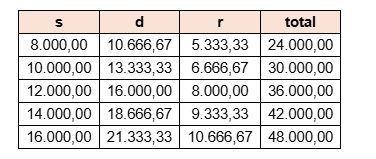
Ivy Joseph also found these five answers that work:
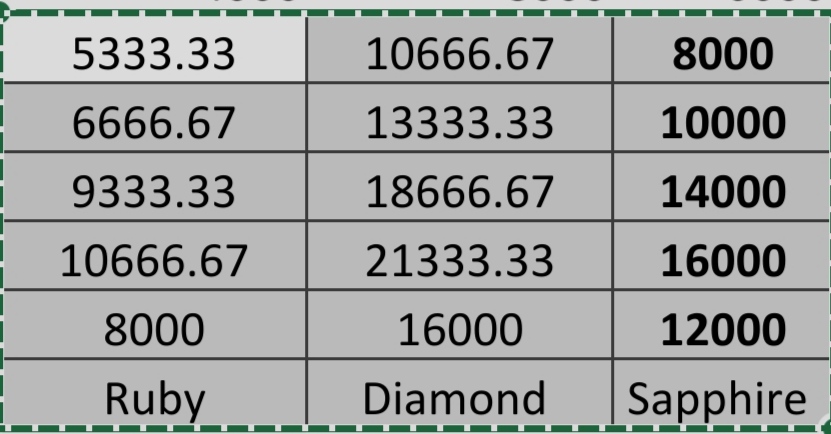
There was nothing in the problem that prohibited non-integer solutions!
Correctly solved by:
| 1. Kamal Lohia | Hisar, Haryana, India |
| 2. Colin (Yowie) Bowey | Beechworth, Victoria, Australia |
| 3. Dr. Hari Kishan (found 5 answers) |
D.N. College, Meerut, Uttar Pradesh, India |
| 4. Davit Banana (found 5 answers) | Istanbul, Turkey |
| 5. Ivy Joseph (found 5 answers) | Pune, Maharashtra, India |